At Beentara, every business starts simple.
A few customers.
A small team.
A handful of tools.
At first, everything works.
Customer inquiries come through WhatsApp. Invoices are created manually. Team communication happens over phone calls and emails. Documents are stored wherever there’s space.
Then growth happens.
More customers arrive.
More employees join.
More processes are created.
And suddenly, the systems that once felt manageable begin creating friction.
The challenge isn’t growth itself.
The challenge is what growth exposes.
The Hidden Cost of Disconnected Tools
Many businesses unknowingly build their operations around disconnected software.
One platform manages invoices.
Another manages employees.
A different tool handles customer communication.
A separate system powers the website.
Analytics live somewhere else.
Files are stored somewhere else again.
Each tool may perform its individual job well.
The problem begins when none of them communicate with each other.
Teams spend time searching for information instead of using it.
Data gets duplicated.
Processes become manual.
Decisions become slower.
As businesses grow, this complexity grows with them.
What initially feels like flexibility eventually becomes operational overhead.
Growth Should Create Opportunities, Not More Work
One of the biggest misconceptions in business is that scaling requires adding more software.
In reality, most growing organizations don’t suffer from a lack of tools.
They suffer from a lack of connection between those tools.
Business owners often find themselves managing software instead of managing their business.
The result is predictable:
More subscriptions
More manual work
More training
More data silos
More operational complexity
Yet the goal of technology was supposed to be the opposite.
Technology should reduce friction, not create it.
The Shift Towards Business Ecosystems
Forward-thinking businesses are beginning to move away from isolated applications and toward connected ecosystems.
Instead of asking:
“Which tool should we add next?”
They’re asking:
“How do we create a system where everything works together?”
This shift changes the way businesses operate.
Customer information becomes accessible across teams.
Workflows become automated.
Operations become more visible.
Decision-making becomes faster.
Growth becomes easier to manage.
The focus moves away from software management and back to business growth.
What Modern Businesses Actually Need
The businesses growing fastest today are not necessarily the ones with the most tools.
They’re often the ones with the simplest systems.
A modern business platform should help organizations:
Build and manage their digital presence
Organize operations from a central location
Coordinate teams efficiently
Automate repetitive processes
Access intelligent insights
Scale without constantly rebuilding infrastructure
Most importantly, it should reduce complexity rather than add to it.
Why We Built Beentara
This challenge is exactly what inspired the creation of Beentara.
Over the years, we observed a common pattern across businesses of different sizes and industries.
The problem was rarely a lack of ambition.
It was the growing complexity of managing disconnected systems.
Business owners were spending valuable time switching between platforms, moving information manually, and maintaining processes that should have been automated.
Beentara was designed around a simple idea:
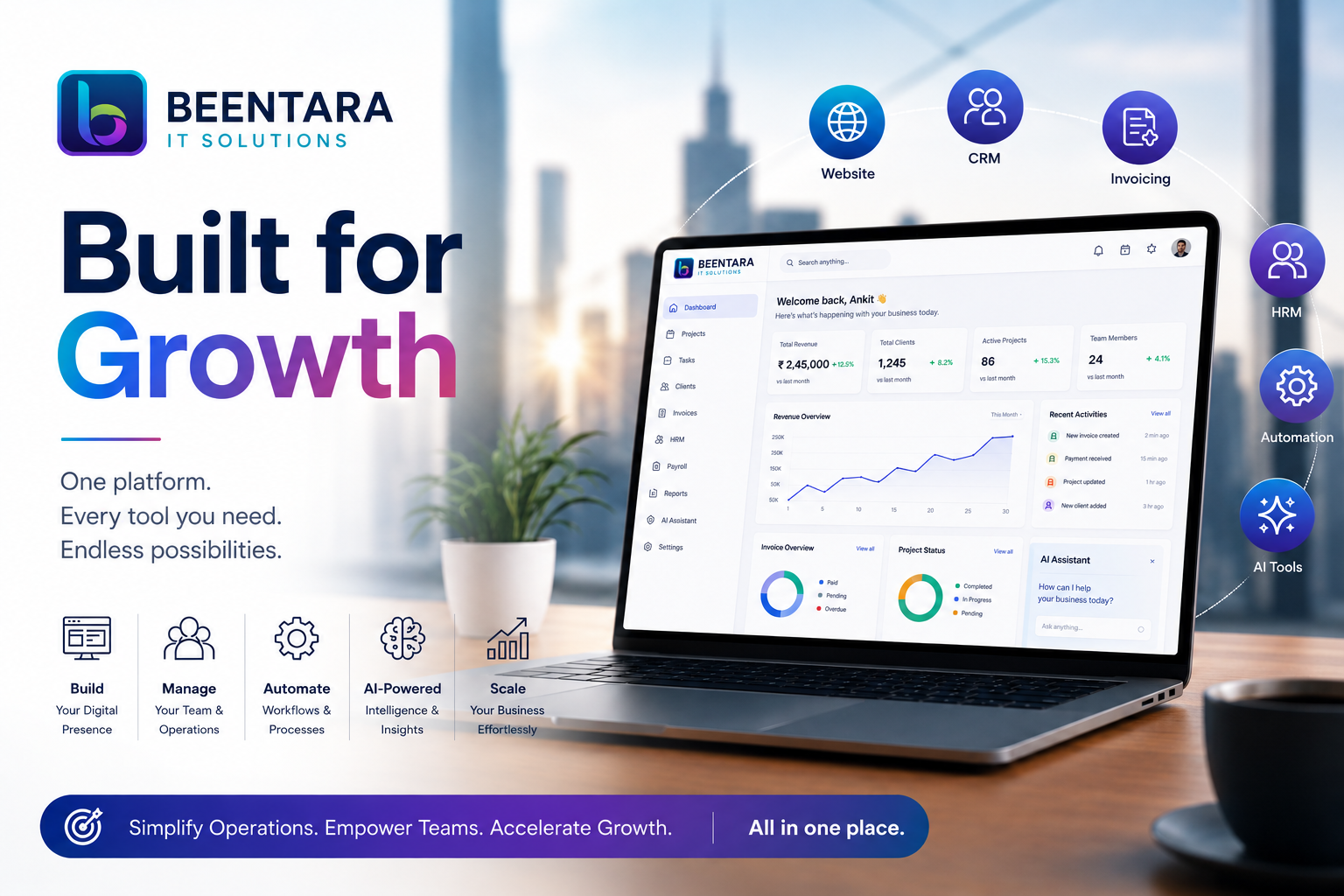
Businesses deserve an ecosystem, not a collection of disconnected tools.
Instead of forcing organizations to assemble multiple systems and make them work together, our goal is to provide a connected environment where essential business functions can operate as one.
Not because businesses need more software.
But because they need fewer barriers to growth.
The Future Belongs to Connected Businesses
The pace of business is accelerating.
Customers expect faster responses.
Teams expect better collaboration.
Markets demand greater agility.
In this environment, operational simplicity becomes a competitive advantage.
The businesses that thrive won’t necessarily be the ones with the largest budgets or the most software.
They will be the ones with systems designed for growth.
Technology should not feel like something businesses have to manage.
It should feel like infrastructure quietly working in the background while businesses focus on what matters most: creating value, serving customers, and growing sustainably.
That’s the future we believe in.
That’s what Beentara is built for.